The Sophia Protocol — Wisdom in the Cipher
THE DISPATCH
Donn Belmont
5/14/20263 min read
If you want to hide a secret from the world, you don't use a lock; you use a language that only the initiated can speak.
In our previous posts, we established that the Knights Templar were legally "suspended" but never truly dissolved. They became a ghost in the machine. But why? Why go through the effort of maintaining a hidden network for centuries? The answer lies in what they were protecting: a stream of ancient, pre-Christian wisdom that the medieval world wasn't ready to hear.
The Accusation: The Head of Baphomet
During the trials in 1307, one of the most consistent—and bizarre—accusations was that the Templars worshipped a severed head or an idol named Baphomet. For seven hundred years, this has been used to paint the Order as devil worshippers.
But if we stop looking at it through the lens of 14th-century propaganda and start looking at it through the lens of cryptography, a different picture emerges.
The Atbash Cipher: The Code of the Holy Land
The Templars spent nearly two centuries in the Levant. They didn't just fight; they interacted with Jewish scholars, Sufi mystics, and Gnostic sects that had survived since the time of the Pharaohs. They learned their methods of hiding information.
One of the oldest tools in the box is the Atbash Cipher. It’s a simple substitution code used in the Hebrew alphabet where the first letter is swapped with the last, the second with the second-to-last, and so on.
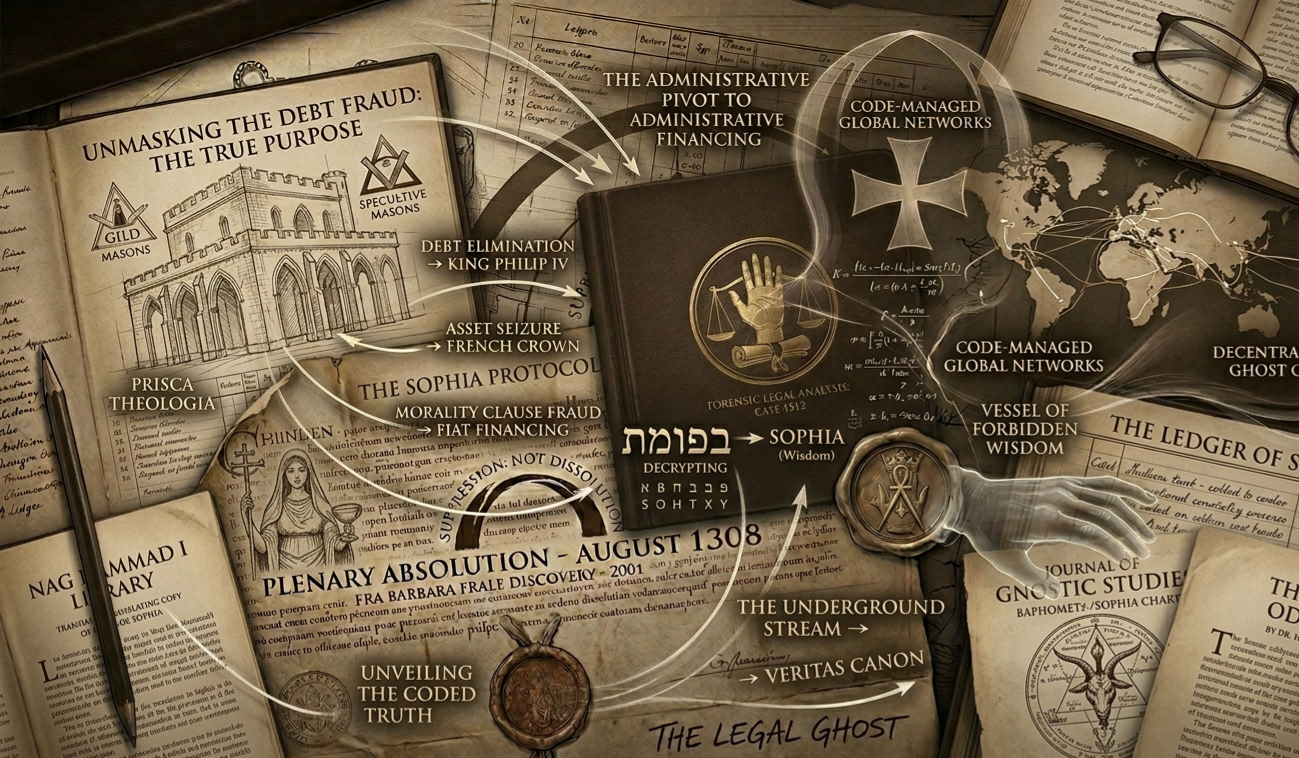
When you apply the Atbash Cipher to the name Baphomet (בפומת), it decodes perfectly into the Greek word Sophia (שופיא).
The Fact: "Sophia" is the Greek word for Wisdom.
The Doubt: Were the Templars worshipping a demon, or were they using a code to signal their devotion to the "Goddess of Wisdom"—a concept central to Gnosticism and Hermeticism?
Sophia: The Forbidden Knowledge
In the Gnostic tradition, Sophia represents the divine feminine, the spark of wisdom that exists outside the rigid hierarchy of the institutional Church. To the Church in 1312, this was the ultimate heresy. It suggested that an individual could reach "God" or "Truth" through knowledge (Gnosis) rather than through the Pope.
The Templars were the guardians of this "Underground Stream." Their architecture—the octagonal chapels, the specific geometry of their cathedrals, and their obsession with the Temple of Solomon—wasn't just for show. It was a textbook written in stone, preserving the Hermetic and Egyptian principles of "As above, so below."
The Hermetic Connection
We see the "Sophia" connection everywhere once we know what to look for. It’s in the transition from the Templars into the early scientific and philosophical societies of the Renaissance. It’s the idea that there is a Prisca Theologia—a single, true theology that existed in ancient times and has been passed down through a chain of initiates.
The Fact: The Templars were documented as having close ties with the "Master Builders" (the Masons) who utilized sacred geometry.
The Ghost: When the Order went underground, this wisdom didn't vanish. It moved into the craft gilds and the secret academies that eventually birthed the Enlightenment.
Conclusion: The Mission of the Ghost
The Templars didn't remain a "ghost in the machine" just to keep their money. They did it to ensure that the "Sophia Protocol"—the preservation of ancient wisdom—survived the fires of the Inquisition.
By labeling their wisdom "Baphomet," the Church thought they were exposing a demon. In reality, they were just proving they didn't have the key to the code. The Templars knew that as long as the code survived, the wisdom would remain for those who knew how to look for it.
Further Research & Sources:
Dr. Hugh Schonfield: The Essene Odyssey. Schonfield was the scholar who first applied the Atbash cipher to the Templar trials.
The Nag Hammadi Library: For the foundational texts on Gnostic Sophia and the "Forbidden Wisdom."
"The Hiram Key" by Christopher Knight & Robert Lomas: An investigative look at the links between Templar architecture and ancient Egyptian rites.
The Corpus Hermeticum: The primary source for the "As above, so below" philosophy that the Templars likely encountered in the East.