The Legal Ghost: Why the Death of the Templars Was a Lie
THE DISPATCH
Donn Belmont
5/14/20264 min read
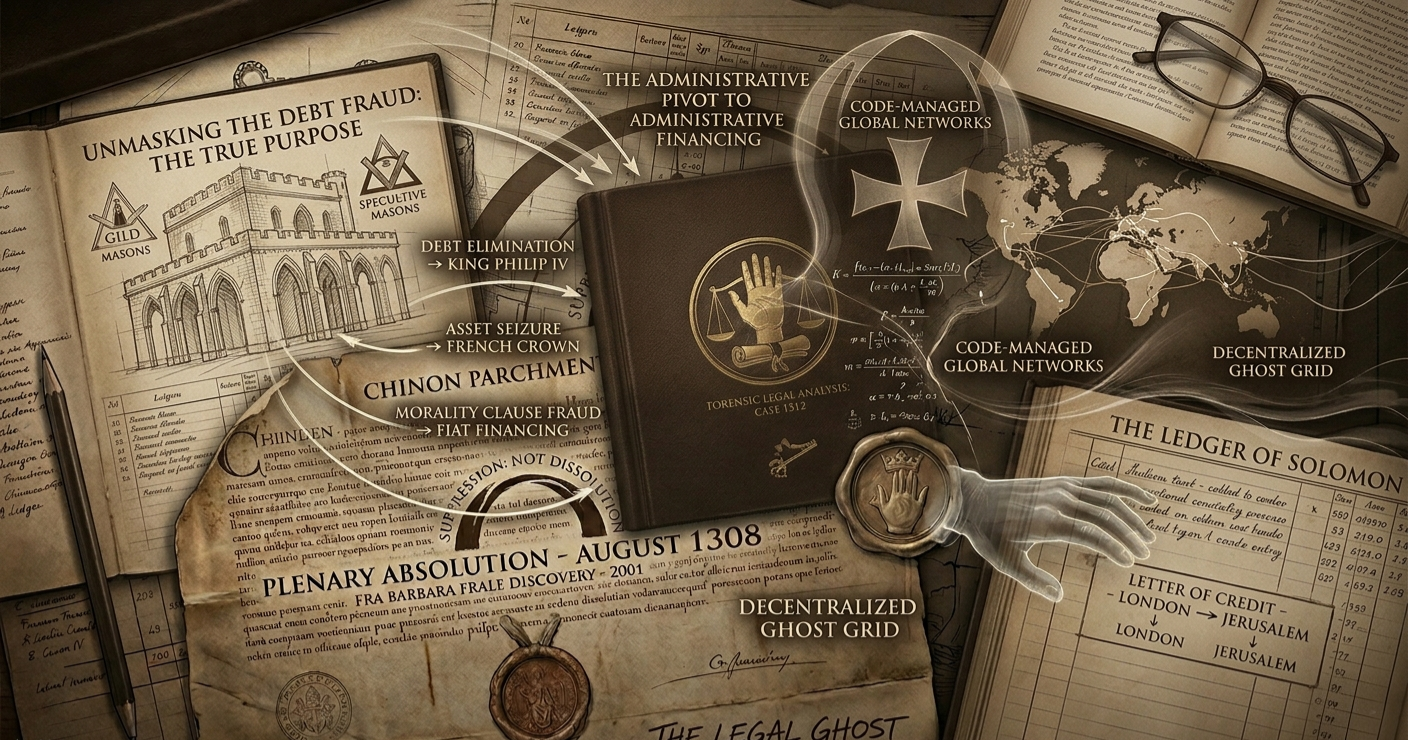
History books love a clean ending. They tell us that in 1312, the Knights Templar ceased to exist. They point to the papal bull Vox in Excelso as the death certificate. But when you actually read the law of the time, you realize that certificate was forged under duress—and more importantly, it didn't actually kill the patient.
To understand why there’s so much doubt about the "disappearance" of the Templars, we have to stop looking at legends and start looking at the paperwork. The paperwork reveals a massive legal failure, and more importantly, the birth of a ghost in the machine.
The Problem with "Guilty": The Chinon Discovery
The standard story is that the Templars were a group of heretics who got what was coming to them. But that narrative hits a brick wall the second you look at the Chinon Parchment. Found buried in the Vatican archives in 2001 by researcher Barbara Frale, this document is the smoking gun of the 14th century.
It proves that in August 1308, Pope Clement V—the man supposedly responsible for ending the Order—actually absolved the top leaders, including Grand Master Jacques de Molay. He found no heresy. He found no "spitting on the cross" as a matter of belief. He found a group of men who had been tortured into confessing things that never happened.
The Fact: The Pope intended to reform the Order, not destroy it. He explicitly granted them plenary absolution.
The Reality: He was being held in a psychological and political vice by King Philip IV of France, who owed the Templars more money than his kingdom could ever repay.
When you see a "fact-based" history book ignore the Chinon Parchment, you have to ask: are they teaching history, or are they repeating 700-year-old French propaganda?
The Loophole: "Vox in Excelso" and the Law of Suppression
In 1312, Clement finally buckled under Philip’s pressure. He issued Vox in Excelso, but he did it with a very specific, very cowardly legal trick. He didn't use a definitive sentence.
In canon law, if you’re going to end an Order for crimes, you issue a definitiva sententia. It’s a final legal judgment based on proven guilt. Clement couldn't do that because he knew they weren't guilty. Instead, he suppressed them by apostolic provision (per viam provisionis).
Think of it like this: A definitive sentence is a judge sentencing a criminal to death because they broke the law. An apostolic provision is a CEO "retiring" a division of a company because the PR is bad.
The Order wasn't "executed" for heresy. It was "administratively suspended" because the King of France was making too much noise. Legally, the Templars weren't dead; they were just out of a job. This is where they stop being a visible army and start becoming the ghost in the machine.
Following the Money: The 14th-Century Corporate Raid
We have to talk about King Philip IV. This wasn't a holy war; it was a hostile takeover.
Philip was bankrupt. The Templars were the world’s first multinational bank. By labeling them heretics, Philip could trigger a "morality clause" in medieval law that allowed him to freeze their assets and seize their land.
The Motive: Debt cancellation. If the person you owe money to is a "heretic," you don't have to pay them back.
The Method: Use the Inquisition as a weapon of the state.
This is where the "conspiracy" ends and the factual corruption begins. We have the records of the French treasury. We see exactly where the Templar gold went. It didn't go to the Church; it went into Philip's war chest. But even with the land gone, the intellectual capital—the knowledge of navigation, masonry, and international finance—remained.
The Vanishing Act: The Fleet at La Rochelle
The real doubt starts when you look at the "missing" people. When the Order was suppressed, thousands of knights simply stopped appearing in the records. They didn't all go to the stake.
On the night of the arrests in 1307, the Templar fleet at La Rochelle vanished. Where did it go? It didn't sink. It didn't surrender. It moved. If you have a global network of soldiers and bankers who have just been told their organization is "suspended" but not "guilty," you don't go home and farm. You take the knowledge, the ciphers, and the gold, and you go underground. You become the hidden hand inside the systems that follow.
Fact vs. Manufactured Narrative
We need to be clear about why we have this doubt to begin with. The doubt isn't based on "ghost stories." It’s based on the fact that the legal documents of the time contradict the "official" outcome.
Fact: The leaders were absolved of heresy in 1308 (Chinon Parchment).
Fact: The Order was never legally "convicted" (Vox in Excelso).
Fact: The King of France had a massive financial incentive to lie.
The Doubt: If the legal dissolution was invalid, then the Order never truly ended. It changed state.
When the law and the money don't match the story, the story is usually a lie.
Further Research & Sources:
The Chinon Parchment (Vatican Secret Archives): The official 1308 absolution record.
Dr. Barbara Frale: The Templars: The Secret History Revealed. Her work in the Vatican archives changed the timeline of the trial forever.
"The Trial of the Templars" by Malcolm Barber: The academic deep-dive into the legal proceedings.
Sophie Kirchgasser: Die Aufhebung des Templerordens (2024). Recent legal scholarship questioning the very validity of the 1312 suppression.
The Council of Vienne Records (1311-1312): Documentation of the bishops' refusal to condemn the Order without proof.