The Ledger and the Sword: How the Ghost in the Machine Built the Modern World
THE DISPATCH
Donn Belmont
5/13/20262 min read
If you want to hide a global power structure, you don’t bury it in the dirt; you bury it in the math.
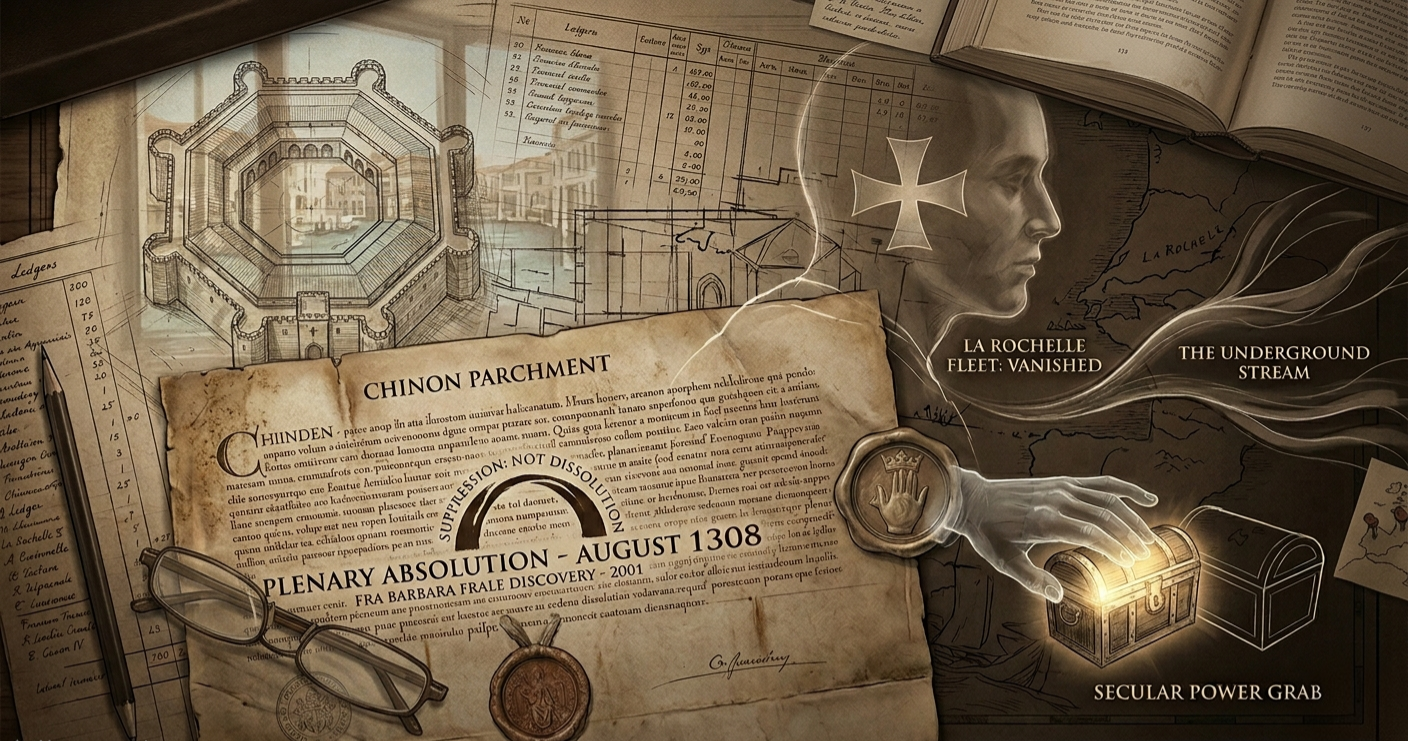
In our first post, we looked at the legal vacuum left behind in 1312. The Knights Templar were "administratively suspended," but their knowledge, their networks, and their vast wealth didn't just evaporate. They became a ghost in the machine—a hidden force that stopped fighting with steel and started fighting with credit.
The Invention of Distance
To understand how the Templars survived, you have to understand what they actually invented. It wasn't just a better way to defend a castle; it was a way to move value without moving physical gold.
Before the Templars, if you wanted to travel from London to Jerusalem with money, you were a walking target for every bandit on the road. The Templars solved this with the Letter of Credit. You’d deposit your gold at a Temple in London, receive a coded document, and then withdraw the equivalent value at a Temple in the Holy Land.
The Fact: This was the birth of the modern banking branch system.
The Ghost: When the Order was officially "suppressed," that infrastructure didn't die. The men who knew how to code those ledgers and manage those networks still existed. They just stopped wearing the crosses.
The 1314 Pivot: From Warriors to Architects
When the Grand Master Jacques de Molay was burned at the stake in 1314, the visible head of the snake was gone. But the body—the maritime fleet based at La Rochelle and the administrative hubs across Europe—was already in motion.
We see the "ghost" appear in the most unlikely places. Look at the sudden, unexplained rise of the Portuguese Order of Christ or the mysterious maritime power of certain families in Scotland. These weren't new organizations; they were the old machine running under a new name.
But the most effective hiding place wasn't another military order. It was the Gilds.
The Master Builders of Finance
The Templars were deeply connected to the master masons and architects of the great cathedrals. These groups shared a specific, hermetic language—a way of communicating through symbols and geometry.
As the 14th century progressed, the "warrior" side of the Templars faded, but the "architect" side took over. They realized that the world was moving away from feudalism and toward mercantilism. They didn't need to own the land if they owned the debt of the people who lived on it.
The Shift: They stopped building stone walls and started building the "Ledger."
The Reality: The modern central banking system—fractional reserve lending, international wire transfers, and sovereign debt—is the direct evolution of the Templar model.
Why the Doubt Exists
The reason we have so much doubt about the "end" of the Templars is because the systems they created are still the ones we use today. You don't see them on the battlefield because they are the battlefield. They are the infrastructure of the global financial machine.
They remained the ghost in the machine because the machine was their greatest invention. By staying invisible, they became invincible.
Further Research & Sources:
"The Knights Templar and the Origins of Modern Banking" – Journal of Economic History.
The Zeno Map & The La Rochelle Fleet Records: Investigating the disappearance of the Templar navy on the night of the arrests.
The Statutes of the Order of Christ (Portugal): Primary documents showing the direct transfer of Templar assets and ideology.
"The Medici Bank" by Raymond de Roover: While focusing on the Medici, this work highlights the Templar-origin systems they utilized to dominate Europe.