
The Anatomy of Distrust: Inside the Black Knight Satellite Myth
EDITORIAL
Valerius Belmont
6/12/20266 min read

The Anatomy of Distrust: Inside the Black Knight Satellite Myth
To understand why a single video circulating on social media can capture the internet's collective imagination, you have to look at the century-old foundation it sits on. The "Black Knight Satellite" is a classic modern myth—a Frankenstein’s monster of folklore constructed by retroactively stitching together entirely separate, genuine historical aerospace mysteries.
But to dismiss the millions of people who look at this myth with curiosity as mere conspiracy theorists is to ignore a fundamental truth about modern history. The public’s willingness to question official space narratives is not born from random paranoia; it is a logical, direct response to a documented historical precedent of military classification, deception, and cover-ups.
1. The Gathering of the Lore
The narrative of an ancient, alien satellite orbiting Earth did not appear overnight. It was built piece by piece from anomalies that genuine scientists and engineers struggled to explain at the time.
The 1899 Tesla Signals
The foundation of the myth begins in Colorado Springs, where Nikola Tesla was experimenting with a massive magnifying transmitter. He intercepted rhythmic, repeating radio signals that regular atmospheric noise couldn't account for. Deeply shaken, Tesla publicly speculated that he had intercepted a transmission originating from an intelligent extraterrestrial source, possibly Mars. Modern astrophysicists suspect Tesla was actually capturing natural, low-frequency emissions from Jupiter’s intense magnetospheric activity or pulsar signals, but the seed of an orbital broadcaster was planted.
The 1927–1928 Long Delayed Echoes (LDEs)
In the late summer of 1927, Norwegian civil engineer and amateur radio operator Jørgen Hals recorded a baffling phenomenon while monitoring shortwave signals from the PCJJ transmitting station in Eindhoven: radio signals returned to his receiver several seconds after the initial transmission had ended. In a vacuum, radio waves travel at the speed of light; a delay of several seconds implied the waves were hitting something incredibly far out in space and bouncing back. This triggered an official international scientific investigation in October 1928, led by physicist Balthasar van der Pol and geophysicist Carl Størmer.
Decades later, in 1973, Scottish researcher Duncan Lunan analyzed the specific delay intervals of Hals’ and Størmer's historical data. He claimed that if you plotted the sequence of the echoes, they formed a star map pointing to the Epsilon Boötis star system, translating to a message from an interstellar probe parked in Earth’s orbit for 13,000 years. While Lunan explicitly retracted his conclusion a year later, admitting his methods were unscientific and based on flawed data, the UFO community permanently absorbed the "13,000-year-old probe" timeline into the Black Knight lore.
The 1954 Pre-Sputnik Panic
In 1954, major newspapers across the United States ran sensationalized articles quoting UFO researcher and retired Marine Corps Major Donald Keyhoe. The reports claimed that the U.S. military had detected two artificial satellites orbiting Earth. This caused a massive public stir because humanity was still three years away from launching Sputnik 1 (1957). The Pentagon eventually clarified that astronomer Dr. Lincoln LaPaz had been conducting a search for near-Earth mini-asteroids and meteoroids, and the anomalies detected were entirely natural—but the public remained deeply skeptical of the sudden dismissal.
For decades, these historical events floated in completely separate circles. It wasn't until the late 1990s and early 2000s that early internet forums welded them into a single, cohesive timeline: an ancient, non-human surveillance craft was parked in a polar orbit, watching humanity.
2. The Precedent of Deception: The CORONA Blueprint
Mainstream science and space agencies frequently treat anyone investigating the Black Knight with a sense of clinical condescension. They expect the public to treat aerospace history as a completely neat, transparent sequence of events. However, history proves that aerospace companies and government agencies have actively used misinformation, cover stories, and the excuse of "space debris" to mask classified military hardware overhead.
The definitive proof of this dynamic is Project CORONA, which operated under the public, scientific cover name Project Discoverer from 1959 to 1972.
THE PUBLIC COVER ] [ THE DECLASSIFIED REALITY
+---------------------------------+ +---------------------------------+
| Project Discoverer | | Project CORONA |
| - Civilian Scientific Research | --> | - Joint CIA / Air Force Ops |
| - Atmospheric Data Collection | | - Spy Satellites over USSR |
| - "Accidental Space Debris" | | - Misdirection of Radar Data |
+---------------------------------+ +---------------------------------+
The 1960 Dark Satellite Incident
In February 1960, the U.S. Navy’s dark-satellite detector, the Dark Fence, picked up a massive, dark, tumbling object in a highly unusual polar orbit. A polar orbit is incredibly difficult to achieve because it requires launching a rocket north-to-south, counter to the Earth's natural rotation, rather than west-to-east. Neither the United States nor the Soviet Union claimed ownership of the object. Panic spread through the Department of Defense that the Soviets had developed an untraceable, heavy reconnaissance satellite that could systematically view the entire globe as the Earth rotated beneath it.
The Official Lie
As public anxiety peaked, the military abruptly changed its narrative. They issued public statements asserting that the unknown object was completely harmless: it was simply a broken-off casing from the retro-rocket of the Discoverer 8 satellite launch that had gone off course in late 1959. The public was told to look away; it was just a piece of drifting space junk.
The Declassified Reality
When President Bill Clinton signed Executive Order 12951 to officially declassify Project CORONA on February 24, 1995, the truth completely shattered the official 1960 narrative. "Discoverer" was never an innocent civilian scientific program designed to collect upper-atmosphere data. It was a highly classified, joint CIA-Air Force photo-reconnaissance mission designed to map Soviet missile silos.
The military had intentionally lied to the public, the press, and foreign adversaries about what was orbiting overhead to safeguard an intelligence-gathering asset. They used the absolute classification of space operations to manage public perception.
Once an institution establishes a clear historical precedent of using misinformation to hide orbital hardware, it permanently surrenders the benefit of the doubt. The government proved that if a highly anomalous or classified craft were parked in Earth's orbit, the baseline protocol would be denial, classification, and a "space debris" cover story.
3. Forensic Deconstruction: The Anatomy of a Modern Viral Video
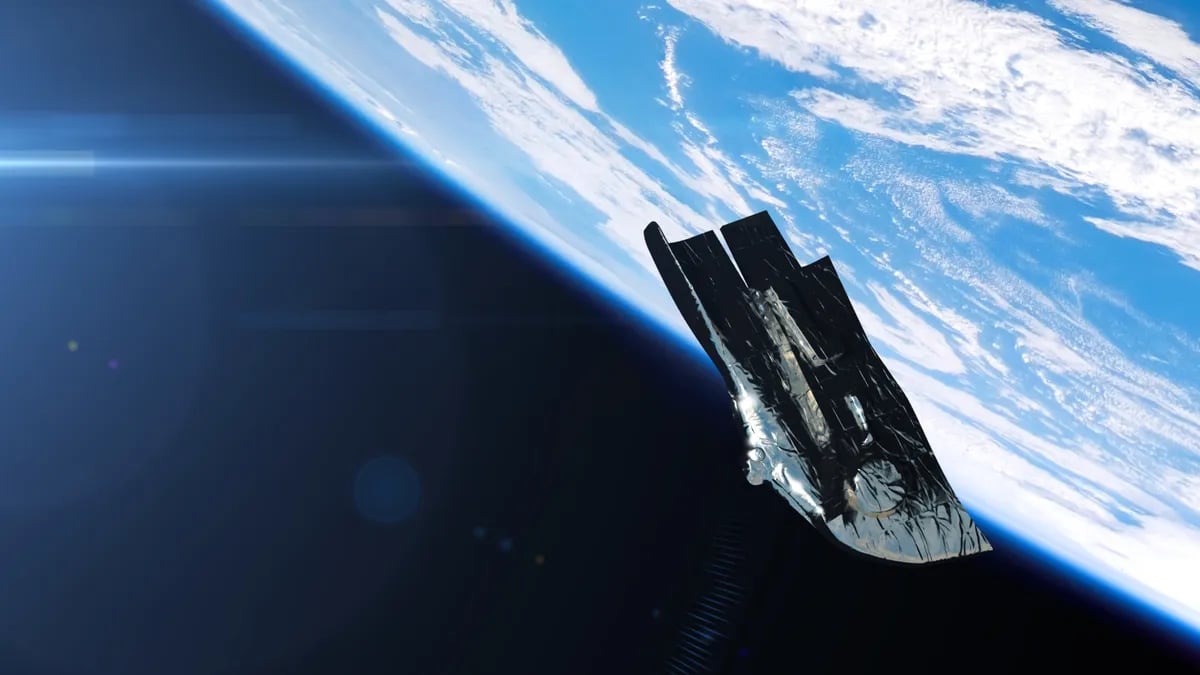
This historical baggage is exactly why the famous December 1998 Space Shuttle Endeavour (STS-88) photographs—and the upscaled videos currently circulating on Twitter/X—command millions of views. When people look at the imagery, they bring decades of earned institutional distrust with them.
However, an objective investigation requires running a strict forensic audit on the media itself. When we break down the viral footage frame-by-frame using digital verification standards, the modern manipulation becomes undeniably clear.
Indicator A: Edge-Smoothing and Generative Artifacts
The video claims to show high-resolution, unedited details of a rigid, complex, metallic structure. However, zooming heavily into the borders where the dark object meets the blackness of space reveals a telltale "greasy," smoothed-out pixel gradient. This is a definitive digital fingerprint. Genuine 1998 aerospace cameras produced sharp, pixelated digital noise and grain. The smooth texture in the viral video is the result of modern AI upscaling software or a custom 3D model rendered over a static NASA background frame.
Indicator B: Post-Production "Documentary" Motion
The video relies heavily on dramatic lens zooms, focus re-adjustments, and a subtle camera shake to make the object feel massive, volatile, and physically present in a real environment. Authentic archival footage from the STS-88 mission was captured by stable, bulkhead-mounted cameras or tightly controlled handhelds operated by trained astronauts in zero gravity. The dramatic camera rumble in the clip is a human-engineered editing trick added in post-production software to trigger an emotional, visceral reaction in the viewer.
Indicator C: Contextual Cropping and Orbital Physics
The viral video intentionally keeps the object tightly cropped and isolated. If you zoom out to the full, unedited NASA photographic sequence (**STS088-724-66** through 724-70), the broader physical environment reveals itself.
The object is moving at the exact speed, orientation, and relative trajectory of a thermal insulation blanket (specifically, a trunnion pin cover) that floated away during an EVA. While securing a thermal cover on a trunnion pin—a mounting point used to secure the Unity connecting module in the shuttle's cargo bay—the blanket was incorrectly tethered and slipped away from astronauts Jerry Ross and James Newman.
The Visual Disconnect: To the human eye, the blanket looks solid, rigid, and jet-black because one side was finished with a dark, non-reflective material, and it was crumpled in the vacuum of space. The video exploits this visual incongruity. It takes a piece of loose, lightweight fabric that was logged, tracked by space debris networks as object ID 25570, and eventually burned up in the atmosphere days later, and uses tight editing to make it appear like an active, self-propelled craft.
Conclusion: An Earned Distrust
Ultimately, the viral video circulating on social media is a digital illusion—an engineered hoax designed to harvest engagement clicks. The physical object photographed in 1998 has a verified, mundane identity. The Black Knight satellite, as a singular ancient entity, is an internet-era myth.
Yet, the phenomenon cannot be dismissed as mere foolishness. The public's immediate impulse to look at NASA's "dropped space blanket" explanation and completely reject it is entirely earned.
When institutions spend decades classifying aerospace anomalies, hiding surveillance programs under civilian scientific covers, and lying about what is flying through the upper atmosphere for national security reasons, they forfeit public trust. The Black Knight satellite may be a fiction stitched together from space debris, AI edits, and misidentified radio echoes—but the skepticism surrounding it is a completely rational response to a century of official secrecy.
"Prove all things; hold fast that which is good." — 1 Thessalonians 5:21