[ARCHIVE 033] THE TEMPLAR TRANSITION: ARCHITECTS OF THE UNSEEN SYSTEM [CHRONOLOGY: 1118 AD – 1307 AD // 1914 RESET BRIDGE]
THE DISPATCH
Donn Belmont
3/18/20264 min read
History is often presented as a series of accidents, but if you look at the architecture of power, you see a deliberate design. To understand why the world shifted in 1914, you have to look at the group that first mastered the art of "The System": The Poor Fellow-Soldiers of Christ and of the Temple of Solomon.
The Foundation: Nine Men and a Secret
In 1118, nine French knights led by Hugues de Payens arrived in Jerusalem. They told King Baldwin II they were there to protect pilgrims on the road from Jaffa to Jerusalem. For the first nine years, they took in no new members. They lived in a wing of the royal palace, which sat directly over the ruins of the Temple of Solomon.
While the history books say they were patrolling roads, the archaeological record suggests they spent those nine years excavating. When they finally returned to Europe in 1127, they weren't just "poor knights" anymore. They carried the endorsement of Bernard of Clairvaux and a level of papal privilege that placed them above the laws of kings.
They had found something. And whatever it was, it allowed them to build a sovereign state within every nation in Europe.
The Birth of the Global Ledger
By the mid-1100s, the Templars had transitioned from warriors to the world's first true international bankers. They developed a system of scrip and ledgers. A pilgrim could deposit 100 gold coins in Paris, receive a coded parchment, and withdraw the equivalent in Jerusalem.
This was the birth of Fiat—money based on faith in the institution rather than the physical transport of gold. By the time the Order reached its peak, they owned over 9,000 manors and commanderies. They were the creditors to the Kings of France and England. They had created a "Grid" that connected the wealth of the West to a single, centralized command structure.
The Gnostic Infiltration: The Middle Eastern Intercept
As the Templars managed the logistics of the Crusades, they became the bridge between the West and the esoteric East. In the Levant, they encountered the Johannites and the Gnostics—groups that held "Secret Knowledge" (Gnosis) dating back to ancient Babylon and Egypt.
The Gnostic worldview is fundamentally different from the Gospel. It posits that the physical world is a flawed construct—a "Matrix"—and that the elite can transcend this world through ritual and hidden knowledge.
By the late 1200s, reports began to surface within the Order of strange rituals conducted behind closed doors. The red cross remained on their mantles, but the artifacts they left behind began to tell a different story.
The Abraxas Artifacts: Decoding the Symbol
The most significant evidence of this shift is found in Templar Seals. While common knights used the image of two men on one horse (symbolizing poverty), the high-ranking leadership utilized symbols that had no place in Christian theology.
The most prominent was Abraxas.
Abraxas is a figure from 2nd-century Gnosticism, most famously associated with the teacher Basilides. The figure is a composit
The Head of a Rooster: Symbolizing the sun, or the "Awakening" (Phanes).
The Torso of a Man: Symbolizing the human vessel.
The Legs of Serpents: Symbolizing the Logos or the dual nature of wisdom and the earth.
The Shield and Whip: Symbolizing the power to protect and the power to drive humanity.
In the Greek system of Isopsephy (the precursor to Gematria), the letters of the name Abraxas (A=1, B=2, P=100, A=1, \Xi=60, A=1, \Sigma=200) sum exactly to 365.
To the Gnostic elite, Abraxas represented the Supreme Architect of the 365 heavens—the force that governs the cycles of time. By adopting this symbol, the Templar leadership was signaling that they were no longer serving the Church, but the "Grand Design" of the ages. They had moved from being soldiers to being "Architects."
The Trial of 1307: The Declassified Charges
On October 13, 1307, the "System" turned on the Order. King Philip IV of France, heavily in debt to the Templars, launched a coordinated raid. The thousands of pages of trial testimony—often dismissed as "forced confessions"—contain specific, recurring details that align with Gnostic ritual:
The Denial: New initiates were allegedly told to spit on the Cross, signifying that the physical death of Christ was an "illusion" or irrelevant to the Gnostic path.
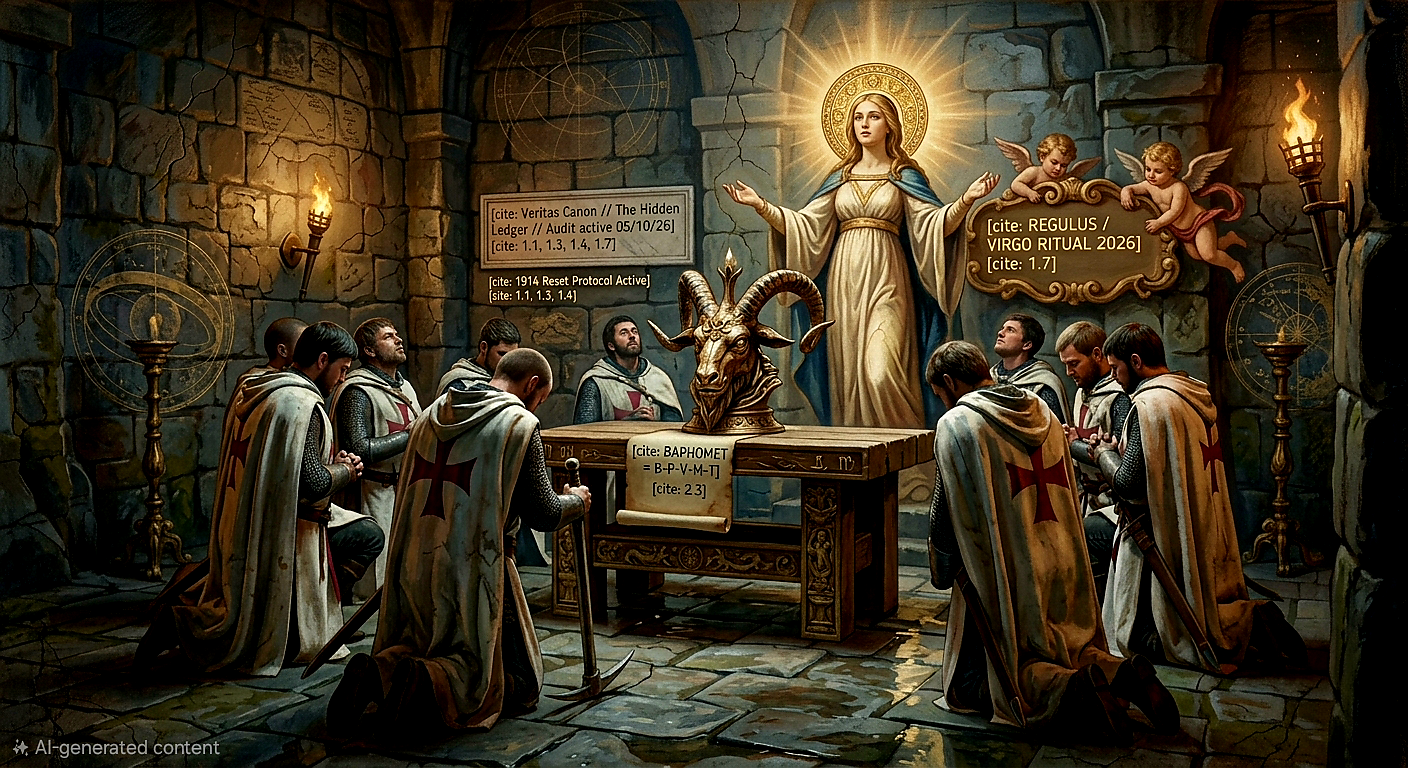
The Head: The worship of a "head" or "idol" called Baphomet. Modern research into the name suggests it may be a coded version of the Greek Sophia (Wisdom), or a representation of the dual-natured Abraxas.
The Secret Cord: Knights were given a small cord of white wool that had been "consecrated" by touching the idol, a practice identical to ancient Gnostic and Cathar "consolamentum" rites.
The Dispersal: Following the Bloodlines
The Order was officially abolished in 1312, but the wealth and the "Knowledge" did not vanish. The Templar fleet, the largest in the world, disappeared from the port of La Rochelle before the arrests.
History tracks their dispersal into three main veins:
Scotland: Where they allegedly fought alongside Robert the Bruce and laid the foundations for what would become Freemasonry.
Portugal: Where they rebranded as the Order of Christ and financed the voyages of discovery (the ships of Columbus sailed under the Templar Cross).
The Swiss Alps: Where many believe the Templar banking expertise laid the foundation for the Swiss Banking System, the neutral vault of the global elite.
The 1914 Connection: The Long Game
This brings us to the "Nothing New Under the Sun" reality. The Templars didn't just invent banking; they invented the Deep State. They created a model where an international elite could operate above the laws of any single nation, controlling kings through debt and controlling the masses through symbols.
In 1914, the world saw the final dismantling of the old monarchies that had once dared to challenge the Templars. The creation of the Federal Reserve in 1913 was the technical completion of the Templar dream: A global, interest-based ledger controlled by an elite who answer to no one.
The "Occult" nature of the elite today isn't a new trend. It is the continuation of the Gnostic blueprint found under the Temple of Solomon. They still use the same symbols. They still follow the 365-day cycle of Abraxas. And they still use "Crisis" as the whip to drive the population toward their "Grand Design."
Conclusion: Seeing the Pattern
If you look at the facts—the excavations, the seals of Abraxas, the birth of international banking, and the sudden rise of the 1914 system—the story tells itself. You don't have to believe in a "conspiracy" to see the documentation of a transition.
The cross was the shield. The bank was the weapon. The blueprint was the occult.
The question isn't whether the Templars survived. The question is: Who is running the ledger today?